



Table of Contents
Most school events revolve around performance. A debate has a winner because someone argues better, a s cience fair has a winner because someone creates a strong project, and an exam has a topper because someone performs well academically. An ideathon works differently; there’s no marks for memorizing facts here. What matters is how well a student can break down a real problem and pitch a workable solution to it. This difference is exactly why CBSE and IIT Delhi now support ideathons at a national level, through initiatives like the School Youth Ideathon
According to Channel Drive, a record 1.02 lakh teams from more than 10,000 schools took part in the 2025 edition, with 2,01200 teams advancing to a video-pitch round, 500 shortlisted for interviews, and 125 selected for the grand finale. That kind of scale doesn’t happen for a format that doesn’t work.
This guide breaks down what an ideathon actually is, and, most importantly, how it is different from a hackathon. It explains what happens at each stage of a real ideathon, the skills students develop along the way, and how a school can successfully host one.
Why an Ideathon is different
An Ideathon is a structured event that is focused on generating, developing, and pitching innovative ideas. It emphasizes brainstorming, creative thinking, and conceptualizing solutions rather than building a prototype. The core deliverable is the reasoning behind the idea, why the problem is real, who it affects, and why the proposed solution could actually work.
Ideathons vs Hackathons
People often use these two terms interchangeably, and it is an understandable mix-up since both involve teams, a deadline, and a final presentation. As iScalePro’s breakdown of this format explains, the real difference comes down to what teams spend their time producing.
A hackathon is focused on execution. Teams write code, build a working demo, and get judged largely on what they managed to actually construct in the time given. That means hackathons usually require students who already know how to program, and they need laptops, stable internet, and often specific software for every participant on the team.
An ideathon asks for something else. Teams are not expected to build anything functional. They’re judged on how well they understood the problem, how creative and realistic their proposed solution is, and how clearly they can explain it. A student with zero technical background can walk into an ideathon and contribute something genuinely valuable, a sharp observation about a problem in their community, a fresh perspective on why an existing solution is failing. That’s part of why ideathons scale so easily at the school level. All that’s really needed is a room, something to write on, an idea, a team, and time.
The Confidence an Ideathon Builds
There is a confidence angle worth naming directly. A student who has already practised sitting with a vague idea and working toward it will face the next open-ended assignment, a college application essay, group projects, future interviews, with less hesitation.
A textbook can teach a student what the right answer is. It can’t really teach them what to do when there isn’t one yet. An ideathon fills exactly that gap, and in doing so, it builds a few things a classroom rarely gets the chance to. A few of the most important ones:
● Teamwork.
An ideathon teaches real teamwork, not the divide-and-stitch kind most school projects rely on. Students learn how to work together through the same problem while disagreeing with each other, and still arrive at a shared decision by the end. People can hold different opinions, but the team still needs one mission everyone commits to.
● Patience.
The second thing an ideathon builds is patience, the patience to listen, to evaluate, and to actually sit with a question before rushing to answer it. Teams frequently discover midway through that the problem they assumed existed isn’t quite the real one, once they’ve actually sat with it long enough to look closely.
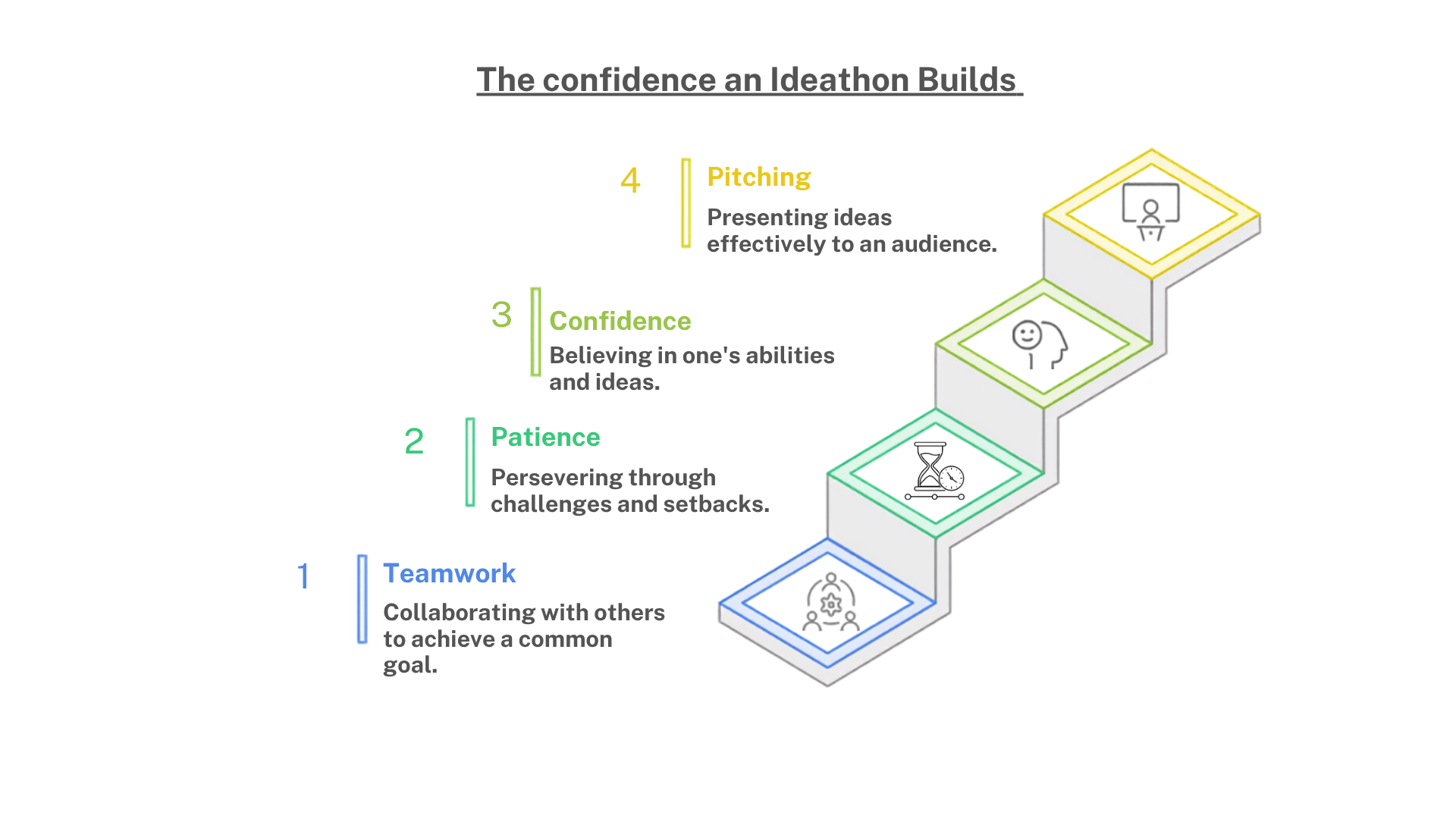
● Confidence.
The third, and arguably the most useful, is confidence. It’s the kind that carries well beyond the event itself, showing up later in a student’s professional and personal life, in how they approach unfamiliar problems, unclear situations, and moments where nobody’s handing them a ready-made answer.
● Pitching.
This is the piece that rarely gets built anywhere else in school. Students have to explain ideas that are still taking shape clearly, defend it under direct questioning from judges, and adjust their thinking on the spot when someone points out a flaw. That kind of real-time communication under pressure is closer to what a student will eventually face in an interview or a professional presentation than a scripted class presentation ever gets them.
What Actually Happens During an Ideathon
“Teams pitch an idea” understates how structured a well-run ideathon actually is. A typical programme runs through four distinct phases, and each one filters for something different, so a team that’s strong at one stage still has to prove itself at the next.
● Orientation
The event opens with a theme release and an orientation session. This is the first and most important stage of an ideathon, since it’s where students understand what’s expected of them before they actually start working on anything. This step is crucial, teams that skip it and jump straight into brainstorming without properly understanding the problem statement tend to end up with weaker ideas later, since they end up solving a version of the problem nobody actually asked them to solve in the first place.
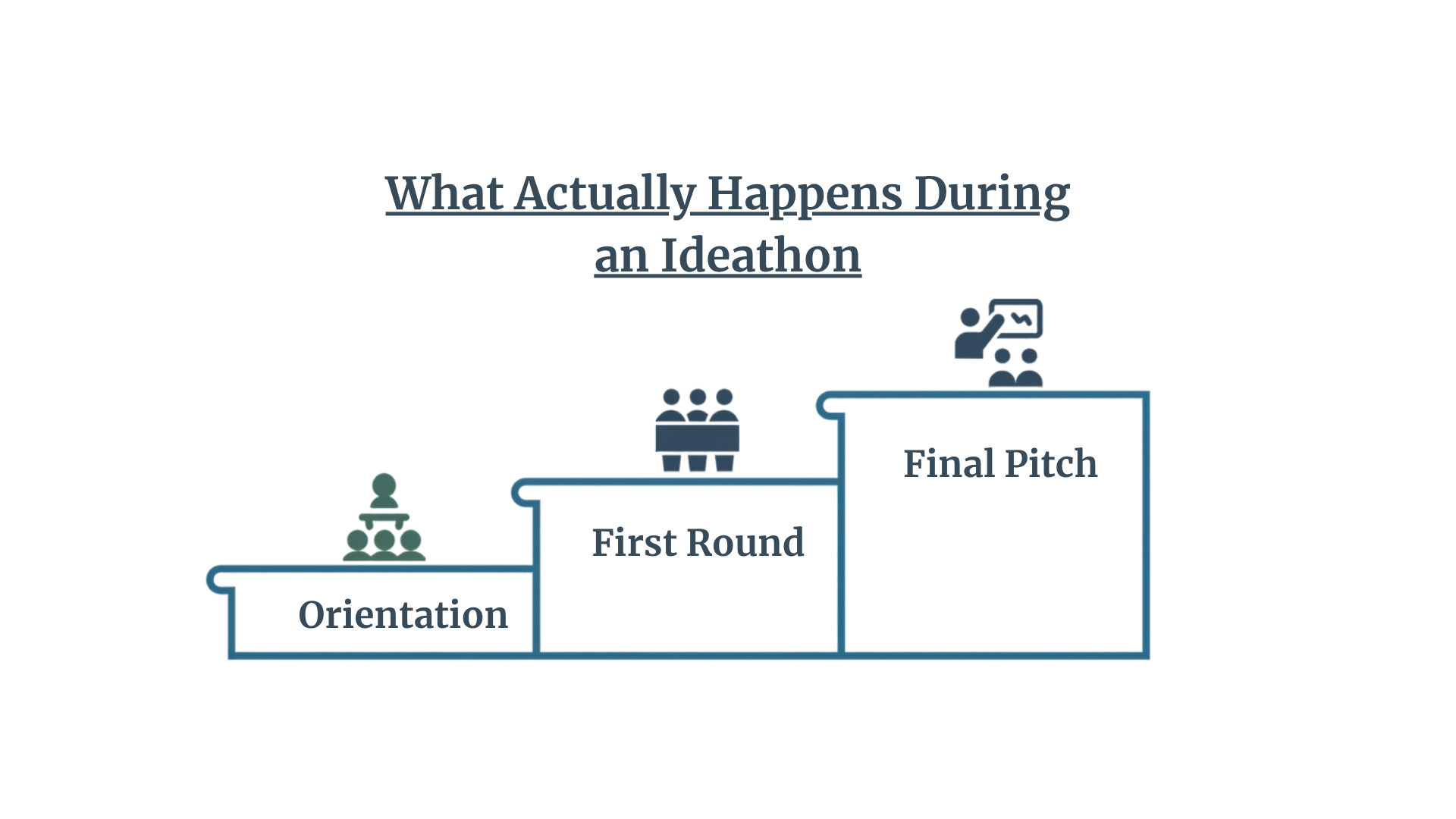
● The First Round
The first round usually runs online and is open to students from Classes 6 to 12, with teams of three to four recommended, and cross-disciplinary teams actively encouraged rather than groups of friends who all think alike. Every team works within a common challenge theme. Teams submit a problem statement, a solution concept, some basic market or user logic, and an initial pitch outline. At this stage, projects are judged on originality, real-world relevance, potential impact, and, most crucially, how well the team communicated it. Out of the full pool of entries, only a small number of finalist teams, often around ten, get shortlisted to move forward.
● The Final Pitch
Shortlisted teams then deliver a live pitch, typically around seven minutes, covering the problem, the solution, who it’s for, a quick look at existing alternatives and what sets their idea apart, the value it creates, and how it would actually get executed.
This is followed by a question-and-answer round where judges push directly on the team’s assumptions. The strongest version of this round runs as an open showcase, with students, faculty, mentors, and invited ecosystem partners in the room rather than a closed panel meeting behind closed doors. Judges are usually a mix of subject matter experts, entrepreneurs, industry leaders, and domain specialists, so the questions students face are closer to what a real founder gets asked on than a typical school evaluation.
What Happens After the Pitch
The prize isn’t really the finish line. In a well-run programme, winning teams move into a structured mentorship period spanning a couple of months. Early on, this focuses on idea refinement, helping students validate whether the problem is real, understand who they’re solving it for, and strengthen the reasoning behind their solution. From there, the focus shifts to project development, guidance on building a rough prototype, MVP planning, and regular mentor feedback to move the idea toward something closer to execution. Promising teams can then get connected to real startup ecosystems, so a strong idea doesn’t just end with a trophy.
This isn’t hypothetical. One student, discovered through exactly this kind of ideathon-to-mentorship pipeline, went on to receive the National Child Award 2024 from the Prime Minister of India after his idea was refined and supported well beyond the event itself. That’s an unusually strong outcome, not the typical result, but it shows what the full pipeline is capable of when a good idea gets real follow-through instead of stopping at the pitch.
How to Organise an Ideathon (Student Innovation and Challenges)
Running an ideathon doesn’t require a large budget or outside sponsors, though both can help it scale further. What it actually requires is a clear structure, since an unstructured “come up with ideas” session tends to produce vague and unfocused results.
Start with a theme specific enough to give students direction, but open enough that they can take it in different directions. “A problem in your local community” works well as a starting point, or tie it to an SDG (Sustainable Development Goals). to give the idea a clearer sense of purpose. “Innovate anything” is too vague, and teams end up spending most of their time just deciding what to work on instead of actually working on it.
Teams of three to five tend to be the right size, small enough that everyone has to contribute, large enough to bring a few different perspectives into the room.
Give teams a clearly communicated timeframe, a few hours for a single-day event, or a couple of days if research time between sessions is useful. Build in short mentor check-ins along the way. Even five minutes with a teacher or an invited professional can redirect a team stuck on a weak idea before they’ve spent their whole session building on a shaky foundation.
Judging should run on a simple, shared rubric covering how real the problem is, how thoughtful the solution is, and how clearly the team can explain it, and this rubric should be shared with students before the event starts, not revealed afterward. A rubric shared in advance also helps mentors give more useful feedback during check-ins, since everyone is working toward the same standard instead of guessing at what judges are looking for.
Schools running their first ideathon often underestimate how much students benefit from seeing a real example beforehand. A short video or a case study of a previous winning pitch gives students a sense of the expected depth without needing a full trial run first. It’s also worth deciding in advance what happens to the winning ideas, even a simple next step like presenting to school leadership gives students a reason to take the process seriously beyond the event day itself. Schools that want support running this end-to-end, from structuring the event and training staff to mentor teams, to connecting standout ideas with incubation support afterward, are increasingly turning to programmes like Codevidhya and Think Startup rather than building the entire process from scratch on their own.
Conclusion
An ideathon gives students something a regular classroom rarely does, a real, open-ended problem with no predetermined answer, and the chance to argue for a solution in front of people who will push back on it. That combination of ambiguity, teamwork, and pitching is hard to build any other way inside a school schedule. You don’t need a big budget or outside sponsors to run one. What you need is a clear structure and the willingness to let students sit with a problem that doesn’t have an obvious answer yet.
Frequently Asked Questions
- What should an ideathon organizer provide to participants?
Answer. A clear theme, a fixed timeframe, and a judging rubric shared upfront, plus short mentor check-ins along the way.
- How do you promote an ideathon and attract participants?
Answer. Keep it simple: a few announcements in class, on notice boards, or through teachers can help spread the word. Once that’s done, you can promote it on Instagram and other social platforms. What really attracts students is the theme itself: a real, local problem feels more meaningful than a vague “innovation challenge.”
- What are the common mistakes when organizing an ideathon?
Answer. Leaving the theme too open and not sharing the judging rubric in advance. Both leave teams guessing instead of actually building.
- How do you measure the success of an ideathon?
Answer. Not just how polished the winning pitch was. How well teams could defend their reasoning under questioning is a stronger signal.
- What happens after an ideathon ends?
Answer. It shouldn’t just end with a trophy. Winning teams typically move into mentorship, refining the idea and sometimes building a rough prototype. Ed tech platforms like Codevidhya’s have built mentorship around exactly this stage.