



The best preparation happens before the pitch.You should understand the problem, know what judges want, divide team roles, test your idea, and practise your pitch.
Here is a step-by-step ideathon winning strategy to help your team prepare before you even step in front of the judges.
Table of Contents
How to Prepare for an Ideathon Before Pitching
Preparation starts before the competition begins. Read the rules carefully. Understand the theme, team size, time limit, submission requirements, and judging process. Then start with the most important part: the problem.
Researching the Problem Before the Clock Starts
Do not begin by asking, “What should we build?”
Start with, “What problem are we trying to solve?”
Look around you.
Think about problems related to education, transport, waste, healthcare, safety, communication, or daily life.
Then ask:
- Who faces this problem?
- How often does it happen?
- Why does it happen?
- What solutions already exist?
- What is missing from those solutions?
For example, imagine students often miss their school bus because they do not know when it will arrive.
Your first thought might be to build a tracking app.
But before doing that, talk to students, parents, and schools. Find out how they currently receive updates.
You may discover that the real problem is not tracking the bus. It may be the lack of a reliable way for schools to communicate route changes.
That is why problem solving should begin with research, not technology.
Building the One-Pager First
Once you understand the problem, put your idea on one page.
Keep it simple.
Include:
- Problem: What are you trying to solve?
- Users: Identify who the problem affects.
- Evidence: What did you find?
- How it works: What would the solution do?
- Difference: Why is your approach useful?
- Impact: What could change?
- Implementation: How can you make it work?
This one-page summary becomes your team’s mental model of the project.
It also makes it easier for everyone to stay on the same page.
If your team cannot explain the idea simply in one page, the final pitch will probably be difficult to follow.
For student teams, you can also define one learning objective. For example, students might aim to understand a local problem, collect evidence, and develop a realistic solution.
Ideathon Judging Criteria Explained
Before developing your idea, find out how it will be judged.
Every ideathon can have different criteria. Some may focus more on innovation, while others may give greater importance to feasibility, impact, research, or presentation.
So always read the official competition guidelines first.
What Judges Are Actually Scoring
Most judges are trying to answer a few basic questions.
Is the problem real?
Show evidence instead of simply saying that the problem exists.
Does the solution address the problem?
Your solution should clearly connect to the problem you identified.
Is it realistic?
You do not necessarily need a finished product, but you should explain how your idea could work.
Who will benefit?
Be clear about who will use the solution and what difference it could make.
Can the team explain it clearly?
A good idea becomes difficult to judge when the presentation is confusing.
For students, the process can also build critical thinking skills. They have to research information, compare options, question assumptions, and explain their decisions.
This follows how students learn and think , which moves from understanding information towards applying, analysing, evaluating, and creating.
Why the Idea Alone Never Wins
A creative idea is only the starting point.
Two teams can have similar ideas but present them very differently.
One may have better research. Another may explain the problem more clearly. Another may show a more realistic implementation plan.
That is why you should not focus only on making your idea sound impressive.
For example:
“We will use AI to improve education.”
This is too broad.
Instead, explain:
- What education problem are you solving?
- Who faces it?
- Why does it happen?
- What exactly will the technology do?
- How will you know whether it works?
The technology should support your idea. It should not become the entire idea.
Ideathon Team Strategy
A good team is not simply a group of friends working together.
Each person should have a clear role.
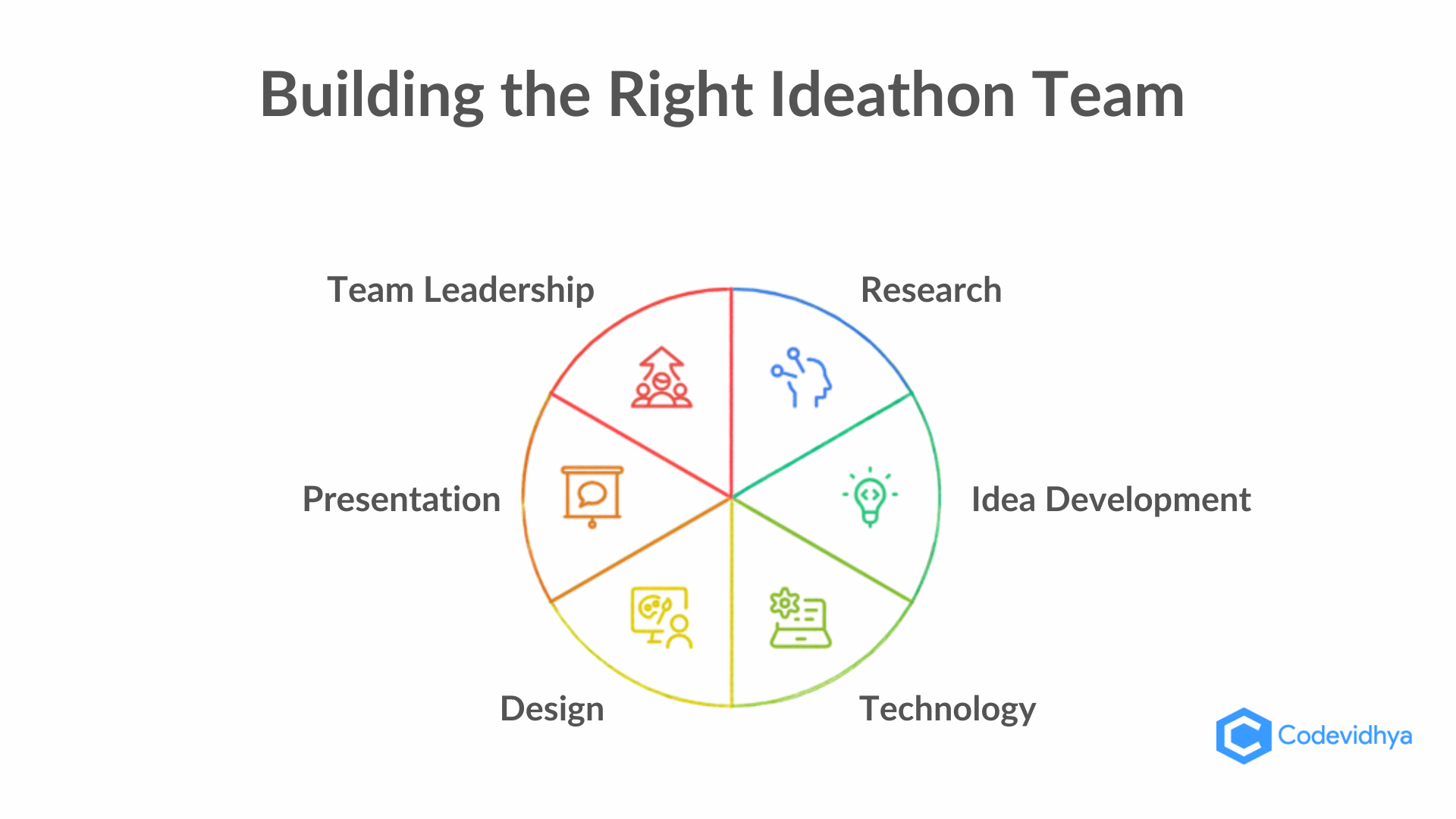
Picking Complementary Skills, Not Friends
Choose people based on what they can contribute.
For example, your team could have:
- Someone who enjoys research
- Someone who develops ideas
- Someone comfortable with technology
- Someone good at design
- Someone confident with presentations
One person can handle more than one role.
The important thing is to have different knowledge and skills across the team.
This makes your ideathon team strategy more effective because different people can focus on different parts of the project.
Assigning a Lead Before You Need One
Choose a team lead early.
The lead does not have to be the best speaker or the most technical person.
Their job is to keep the team organised.
They can make sure that:
- Tasks have owners
- Deadlines are followed
- Decisions are recorded
- Everyone gets a chance to contribute
- The final idea stays consistent
A simple workflow can help:
Research → Choose → Develop → Test → Pitch → Practise → Present
This keeps the team moving without spending too much time on one task.
Common Ideathon Mistakes to Avoid
Sometimes teams struggle because of poor preparation rather than a weak idea.
Here are two common mistakes to avoid.
Falling in Love With the First Idea
Your first idea is not always your best idea.
Before choosing one, explore a few different problems.
Ask:
- Is this problem important?
- Can we research it?
- Do people actually experience it?
- Can we realistically address it?
- Can we explain its impact?
Then compare your options.
This helps students understand that solving problems often involves trying different approaches before finding the right one.
It also stops the team from becoming attached to an idea simply because it was discussed first.
Saving the Pitch for the Last Hour
Do not leave your pitch until the end.
Start building it while you are developing the idea.
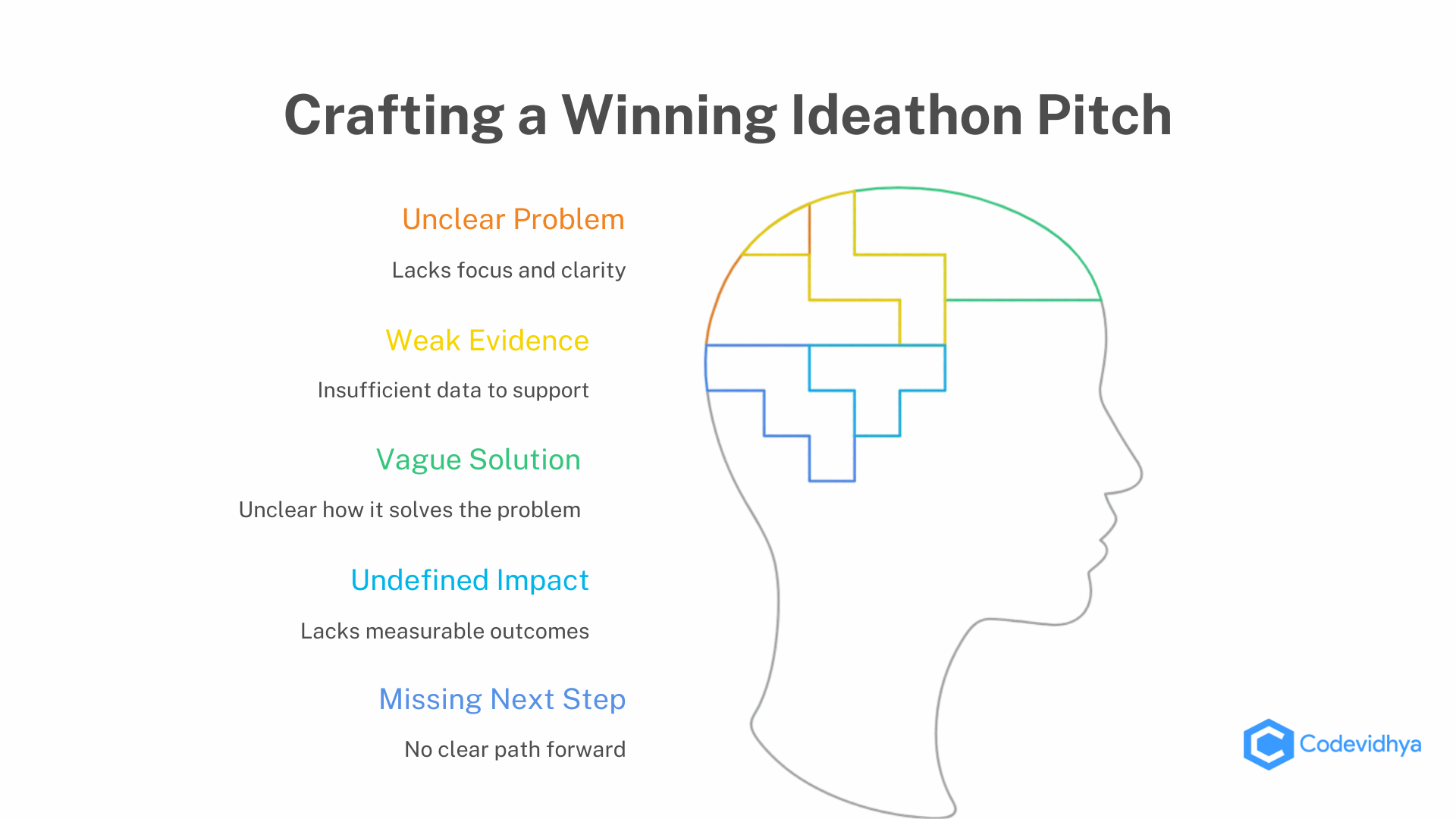
A simple structure is:
Problem → Evidence → Solution → How it works → Impact → Next step
Then practise.
Record the pitch if you can. Listen for parts that are too long or difficult to understand.
Ask someone outside your team to listen to it.
If they cannot explain your idea back to you afterwards, simplify the pitch.
How to Pitch an Ideathon Idea
A strong pitch helps the judges understand the problem before introducing the solution.
Structuring the Pitch Around the Problem, Not the Solution
Start with the person experiencing the problem.
For example:
“Every morning, students wait for their school bus without knowing when it will arrive.”
Now the situation is clear.
Then explain:
- What causes the problem
- Who experiences it
- What you discovered during research
- What people currently do
- Why existing options are not enough
- What your team proposes
- How your solution works
- What impact it could have
Keep the language simple.
if there is use of AI in your idea explain what it does rather than filling the pitch with terms that are technical
For example, saying “Our platform uses a machine-learning model” does not tell the judges much on its own.
Explain what the model does, what information it uses, and how the result helps the user.
If you use a machine-learning model, your team should also understand its training data and recognise that its output can have limitations.
Students do not need to become AI experts.
They need enough AI literacy to explain their idea responsibly.
Handling Q & A Without Getting Defensive
Questions from judges are part of the pitch.
They may ask:
- Why is this solution needed?
- Who will use it?
- How will you implement it?
- What will it cost?
- What happens if it fails?
- What makes it different?
- How will you measure its impact?
Do not panic when you get a difficult question.
If you do not know the answer, say so.
Then explain what you would do next to find it.
For example:
“We have not tested that yet. Our next step would be to test the solution with users and compare the results.”
That shows that your team can make an informed decision instead of simply defending the idea.
How Ideathons Build Skills in Students
An ideathon is more than a competition.
It gives students a chance to take what they learn in class and apply it to a real problem.
During the process, students learn through research, teamwork, experimentation, discussion, and presentation.
These learning experiences can help students develop practical skills that are useful beyond the competition.
They may interview people, analyse information, compare solutions, create prototypes, present their ideas, and improve their work after feedback.
These activities can lead to meaningful learning outcomes because students are applying what they know to real world situations.
Using AI Without Replacing Student Thinking
Students may use ai tools during an ideathon if the competition rules allow it.
They can help with brainstorming, organising research, explaining unfamiliar topics, or exploring possible approaches.
But students should not simply copy an AI-generated answer.
They should check important information against reliable sources.
This is where AI skills for students become useful.
The goal is not just knowing how to use AI. Students should also know when to question it.
For example, if AI provides a statistic, students should check where it came from. If it suggests a solution, they should ask whether the solution actually addresses the problem. If they are using artificial intelligence for research, they should understand that its output may contain mistakes.
Building AI and Media Awareness
Ideathons can also help students build skills for the digital world.
Students regularly encounter information through websites, videos, search engines, advertisements, and social media posts.
They need to know how to question what they see.
This is where data literacy and media literacy become useful.
Students should ask:
- Where did this information come from?
- Is there evidence?
- Could the information be biased?
- Can the claim be checked?
- What information is missing?
Understanding the impact of media helps students become more careful users of information.
A simple AI competency framework for students can also include understanding AI, checking outputs, using data responsibly, recognising limitations, and knowing when human judgement is needed.
The goal is not to stop students from using technology.
It is to help them use it thoughtfully.
Conclusion
A successful ideathon does not start when you walk onto the stage.
It starts with understanding the problem.
Research before you build. Explore different ideas before choosing one. Give every team member a role. Start the pitch early. Practise your explanation. Be ready for questions.
Most importantly, do not try to make the idea sound more complicated than it is.
A clear problem, realistic solution, strong evidence, and simple explanation are easier for judges to understand.
For students, the value goes beyond the competition. Ideathons give young people a chance to research, create, collaborate, communicate, and apply their knowledge to problems around them.
Frequently Asked Questions
- What is the best way to prepare for an ideathon?
Answer. Start with the problem. Research the people affected, understand the judging criteria, assign team roles, test your idea, and practise the pitch.
- How early should I prepare for an ideathon?
Answer. Start as early as the competition rules allow. Early preparation gives your team more time to research and improve the idea.
- What should an ideathon pitch include?
Answer. Your pitch should explain the problem, evidence, people affected, solution, implementation, impact, and next steps.
- How should an ideathon team be formed?
Answer. Choose people with different strengths. Research, creativity, technology, design, and communication can all contribute to the project.
- Can students use AI during an ideathon?
Answer. It depends on the competition rules
If AI is allowed, use it to support your work and verify important information yourself.
- What are common ideathon mistakes?
Answer. Common mistakes include picking the first idea, skipping research,
ignoring judging criteria, rushing the pitch, and making the solution too complicated.