


Ask an Indian household today whether their child could grow up and start a business, and the answer is not the raised eyebrow it might have gotten a generation ago. Shows like Shark Tank India have made pitching and building something your own genuinely aspirational for kids, not just a fallback for those who “couldn’t get into engineering or medicine.” Parents who once encouraged their children to pursue only stable government jobs or corporate careers are now increasingly supporting those who want to create something of their own.
But most of the conversation around these topics stops at the wrong place, what business a child should start, what idea sounds impressive, what age is “right” to begin. That’s the wrong starting point entirely. Whether a child eventually starts a business or not, what actually matters is a set of underlying skills:
Problem-solving, basic money sense, clear communication, and the ability to bounce back when something doesn’t go as planned. These are the same skills that help a child navigate a competitive college admissions process, a first job, or simply a life that increasingly doesn’t follow one fixed, predictable path.
This guide breaks down why these specific skills matter more than any business idea itself, what each one actually looks like in a child, and how they tend to get built in practice, both through everyday life and more structured, mentored experiences.
Table of Contents
Why Entrepreneurial Skills Matter Long Before the First Business Idea
Entrepreneurship is not simply a personality type some kids are born with and others aren’t. According to the recent piece on entrepreneurial activities for the kids, research consistently shows that children who are not naturally risk- takers or outgoing often develop real entrepreneurial capability when they are given the right structured experiences and support. This skill set is not innate, it’s learnable and that matters because it changes the whole question from “does my kid have it in them” to “has this actually been practiced yet.”. These skills also matter regardless of whether a child even runs a business at all. Skills like problem-solving, financial literacy, communication and resilience when it comes to play when it is time for a student to choose a college major, navigate their first job, or handle any unexpected seatback as an adult. It is about building a general comfort with uncertainty, the same comfort that ends up being exactly what starting a business actually requires.
The Core Skills Every Future Entrepreneur Needs
Problem-Solving and Comfort With Uncertainty
Problem-solving is the skills entrepreneurship is built on, as every business at its core is a solution to a problem someone else has. kidprenures.org’s breakdown of skills kids learn from running a business point to how even a small self- directed projects like ideathons and hackathons forces a child to figure out a practical logistics on the fly, where to source the materials from, what to do when something runs out, deciding how to price what they offer or responding to unexpected challenges, they must think on their feet instead of relying on a fixed set of instructions.
What makes hands-on learning different from traditional, theoretical studies is that there isn’t always a single correct answer. In a math problem, students learn a concept, apply a formula, and arrive at a solution that can be checked. But when they work on something real like setting a price, planning logistics, or building a product they have to make decisions, weigh trade-offs, test their ideas, and adapt when things don’t go as planned. This experience teaches children to learn through doing, make decisions in uncertain situations, and adjust based on real outcomes skills that theoretical learning alone often cannot develop.
Basic Financial Literacy
Money habits form far earlier than most people assume. Research from the University of Cambridge found that core financial behaviors, including the ability to plan ahead and delay gratification, are largely set by age seven. That timing matters, waiting until the teenage years to introduce budgeting or saving means working against habits that are already fairly fixed, rather than shaping them while they’re still forming.
This doesn’t require a formal course to start. Ordinary exposure does most of the work, seeing what something actually costs, managing a small amount of money and experiencing what happens when it’s spent all at once, understanding where money in an account actually comes from. The goal is not producing a seven-year-old budgeting expert, it’s making money something a child has had real, hands-on contact with before the stakes get higher.
It can be done through everyday experiences like giving children small amounts of money to manage, involving them in simple purchases, and showing them where money comes from and where it goes.
Communication and the Confidence to Pitch an Idea
Every business idea, no matter how good, eventually has to be explained to someone else: a customer, an investor, a partner. This skill tends to build through everyday practice explaining a line of thinking, not formal presentations. Convincing someone why an idea is worth their time, and adjusting the explanation when it isn’t landing, is the same underlying skill whether the audience is a sibling or a room full of investors.
Entrepreneurial experience specifically strengthens this. A guide on entrepreneurial activities for kids points out that admission officers at competitive universities increasingly look for evidence of initiative and the ability to create value, not just strong grades, and a student who can clearly explain a real project they built has a far more compelling story to tell than one reciting a resume line. The underlying skill, explaining an idea clearly enough that someone else buys into it, matters well beyond any single application or pitch.
One simple way to build this skill is to give children a random discussion topic each weekend and encourage them to explain their ideas confidently.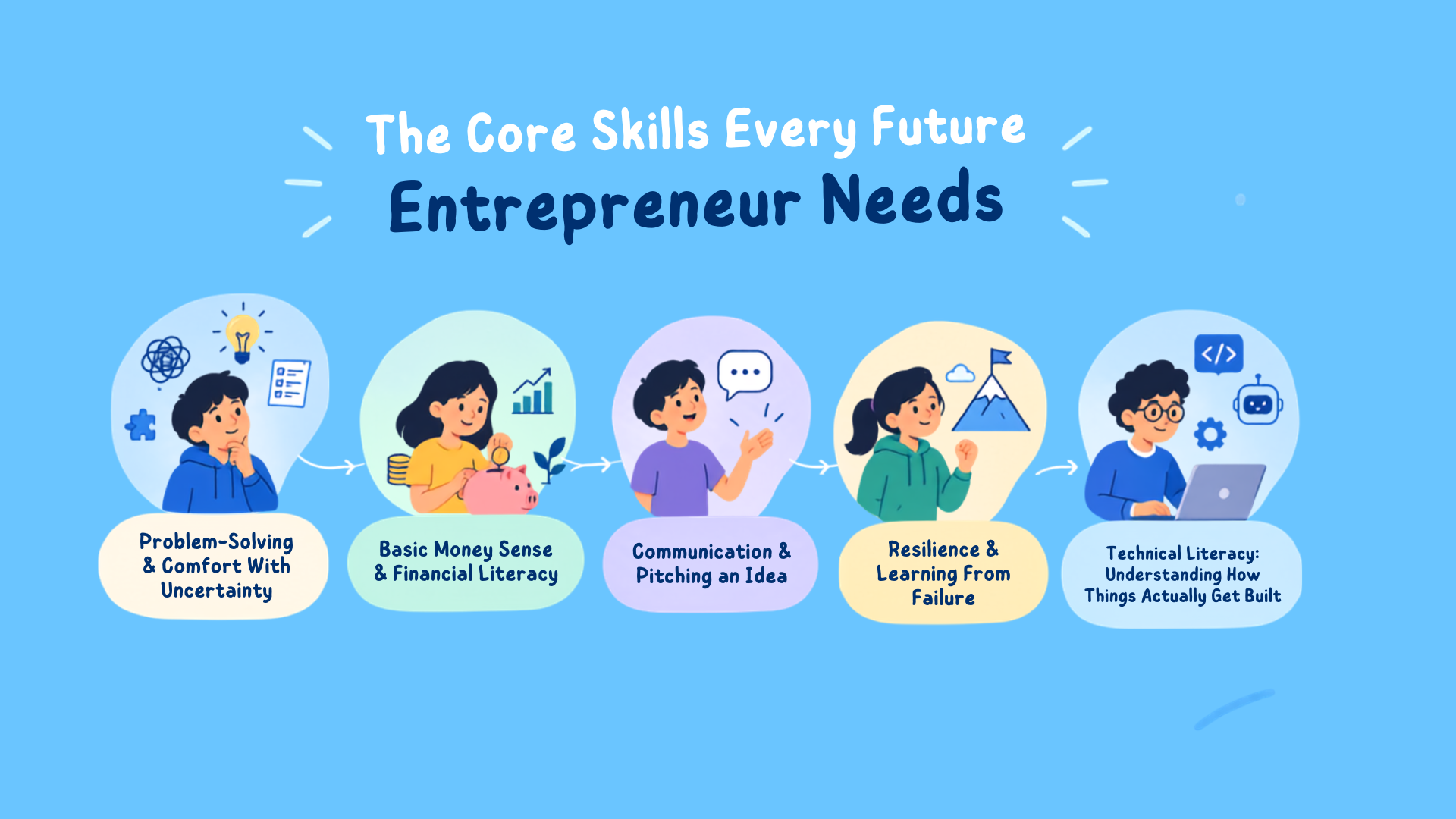
Learning From Failure
Nearly every source on entrepreneurship agrees on one thing: it rarely works on the first attempt. What separates people who eventually succeed from those who don’t is usually not talent, it’s whether failure stops them or teaches them something. A striking example of building this deliberately comes from Spanx founder Sara Blakely. As Forbes reported, her father asked her one question every single dinner growing up: “What did you fail at today?” If she didn’t have an answer, he’d express disappointment, not because she’d failed, but because she hadn’t tried anything hard enough to risk it.
That single habit reframes failure entirely, from something to avoid into something expected, even encouraged, as proof of genuine effort. A child who grows up this way doesn’t experience a failed attempt as evidence they should stop. They experience it as the normal cost of trying something real, which is precisely the mindset that lets adults keep going after a business idea doesn’t work the first time.
|“Everyone is an entrepreneur. The only skill you to be an entrepreneur: an ability to fail, an ability to have an idea, to sell those ideas, to execute on those ideas, and how to be persistent so even as you fail to learn”
James Altucher
Technical Literacy: Understanding How Things Actually Get Built
Almost every business idea today, even a simple one, eventually runs into a technical layer, a website, an app, a basic automation, something that needs to actually be built and not just imagined. A child doesn’t need to become a professional developer to benefit from this, but genuine exposure to how software, AI tools, or basic coding logic work removes a huge barrier that stops a lot of good ideas from ever leaving the whiteboard stage.
This is where the gap between having an idea and understanding how to turn it into a viable business becomes clear. An idea alone is rarely enough. When children understand basic business fundamentals, they can think about who their product is for, what problem it solves, how much it might cost, and whether people would actually pay for it. They learn to test their assumptions, understand what works and what doesn’t, and make better decisions based on real-world outcomes. This gives them the business acumen to look beyond the idea and understand what it takes to make it work.
That is why structured technical education has become such a natural complement to entrepreneurship. EdTech platforms like ThinkStartup and Codevidhya build their programmes around hands-on learning. Students get practical problem-solving experience. These skills give them the tools to move beyond simply pitching an idea. They can start building, experimenting, and turning that idea into something real.
How These Skills Actually Get Built
These four skills don’t appear from a single source, they build up gradually, through a mix of ordinary daily moments and more deliberate, structured practice.
Everyday Moments That Build the Instinct
Ordinary situations already do some of this work. Guidance on nurturing entrepreneurial thinking in children points to daily decisions, planning an outing, managing a small budget, working through a disagreement, as genuine, low-stakes practice for the same reasoning these skills require later. A board game or strategy puzzle does something similar, quietly training foresight and analytical thinking without ever mentioning the word “entrepreneurship.”
What these moments build well is instinct and comfort, a general sense that uncertainty isn’t something to panic about. What they don’t fully build is depth, structured feedback, or exposure to how these skills apply in an actual business context.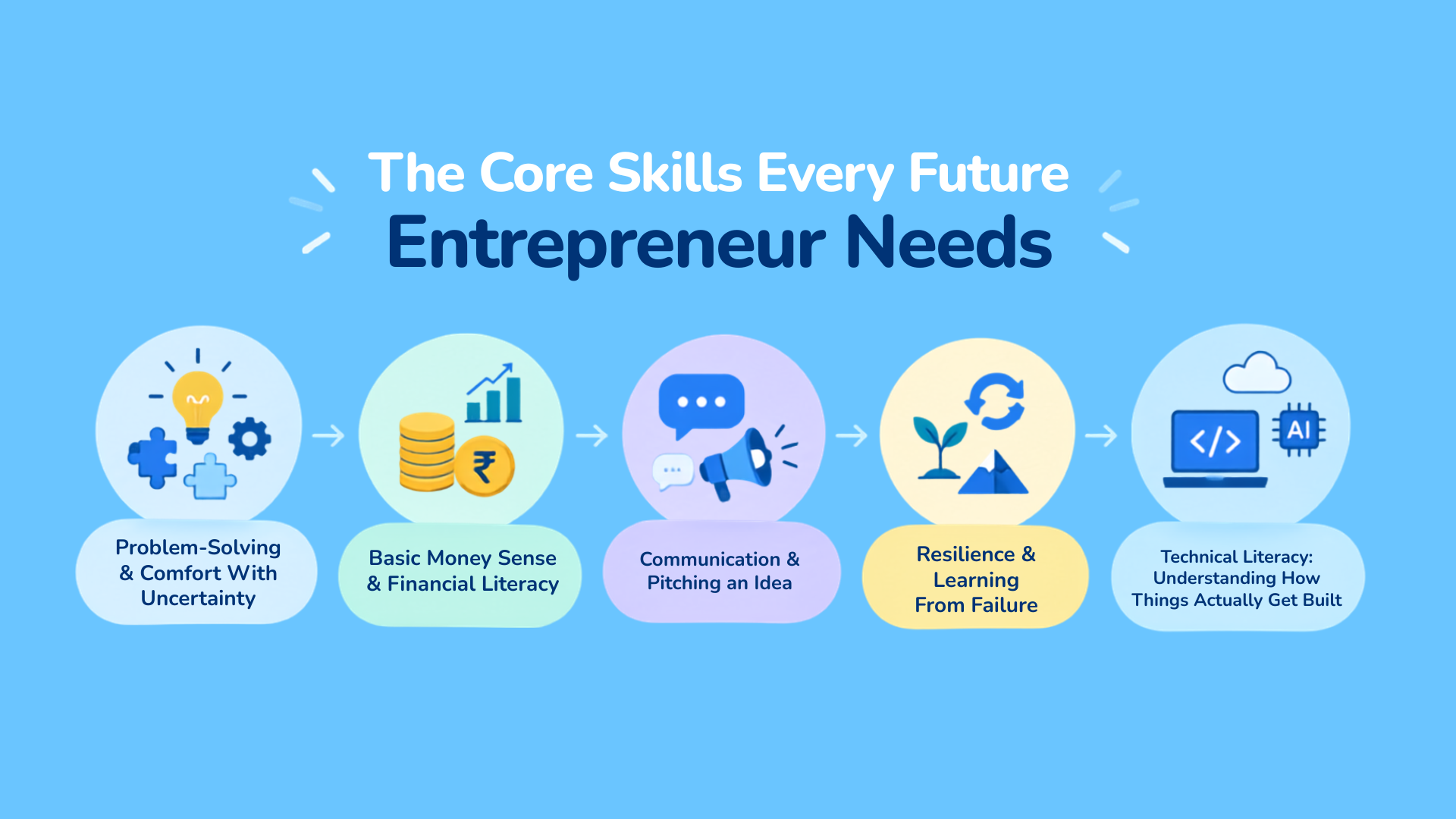
Structured Ways Kids Get Deeper Practice
That’s usually where more deliberate programmes and mentorship come in, giving kids a chance to test an idea with real feedback, pitch to someone outside their immediate circle, or work through a project with a mentor who can push their thinking further than casual daily life typically does. Kidpreneurs.org notes that entrepreneurship education is becoming more common in schools specifically because it gives kids a structured way to identify problems, research solutions, and build something real, rather than encountering these skills only incidentally.
Neither path replaces the other. The everyday instinct-building and the more structured, mentored practice tend to reinforce each other, one lays the groundwork, the other gives it somewhere real to go.
Conclusion
The specific business a child eventually starts, if they ever do, matters far less than whether they’ve had real practice with problem-solving, money, communication, and bouncing back from a setback. These skills build gradually, through the ordinary moments of daily life and, at some point, more structured and mentored practice that takes them further than either path could on its own.
Frequently Asked Questions
- What skills do kids need to become future entrepreneurs?
Answer. Problem-solving, financial literacy, communication, resilience, and technical skills are key foundations.
- Can entrepreneurial skills be learned by children?
Answer. Yes. These skills can be developed through everyday experiences, projects, mentorship, and hands-on learning.
- Why is problem-solving important for young entrepreneurs?
Answer. It helps children identify challenges, explore solutions, make decisions, and adapt when things don’t go as planned.
- Why is technical learning important for future entrepreneurs?
Answer. Technical skills help children move beyond simply having an idea to actually building and testing it. Understanding coding, AI, and digital tools gives them the confidence to create solutions independently. Platforms like Codevidhya and other hands-on learning programmes provide students with practical exposure to these skills, helping turn ideas into real projects.
- What is the ideal age for a child to start learning entrepreneurship skills?
Answer. There is no fixed age to start developing entrepreneurship skills, but children can begin exploring these skills as early as 8 years old through simple, age-appropriate activities and real-world experiences.