


Figure 1: Building foundational logic in the classroom
As a school principal, your inbox is likely flooded with promises about educational AI. Vendors claim their tools can write and even teach code faster than any human instructor and it’s a fair question to ask whether traditional coding education still deserves time and budget.
The scale of this shift is hard to ignore. According to the OECD’s 2026 Digital Education Outlook, generative AI is now reshaping teaching and learning across nearly every subject area, with schools worldwide racing to determine how these tools should or shouldn’t be used in the classroom. Coding classes sit right at the center of that debate, since AI’s most visible skill is writing functional software from a simple prompt.
But this is precisely why coding still matters in schools, not despite that shift, but because of it. As coding education in the age of AI evolves, that foundation becomes more valuable. This guide breaks down exactly why, and how principals can adapt their curriculum to match this shift.
Table of Contents
Should Schools Teach Coding When AI Can Write Code?
It is a big assumption to think coding has become an obsolete skill, made redundant by generative AI’s ability to write functional software in seconds, since that assumes coding education was always about memorizing syntax and correct indentation. It never really was. As one veteran developer educator has argued, fundamentals still matter more than ever, because writing code was always a by-product of a much more valuable skill: structured problems solving. AI has automated the byproduct. It hasn’t automated the thinking underneath it, and that thinking is exactly what a coding classroom is meant to build.
This is where computational thinking comes in; it is the ability to take a complex problem and break it into smaller pieces a human or machine can actually execute. It isn’t tied to any single programming language, and it doesn’t expire the moment a new AI model launches. It’s no longer just a technical skill, it’s a thinking skill that happens to be taught through code.
Computational thinking breaks down into three core components that every coding classroom should still be actively building:
● Decomposition:
Breaking massive, intimidating problems into tiny, logical, solvable steps instead of feeling overwhelmed by the whole.
● Pattern Recognition:
Spotting trends, similarities, and past solutions that can be adapted and reapplied to new, unfamiliar errors or challenges.
● Algorithmic Design:
Writing clear, step-by-step instructions that guide an automated system or a person toward a correct, repeatable outcome.
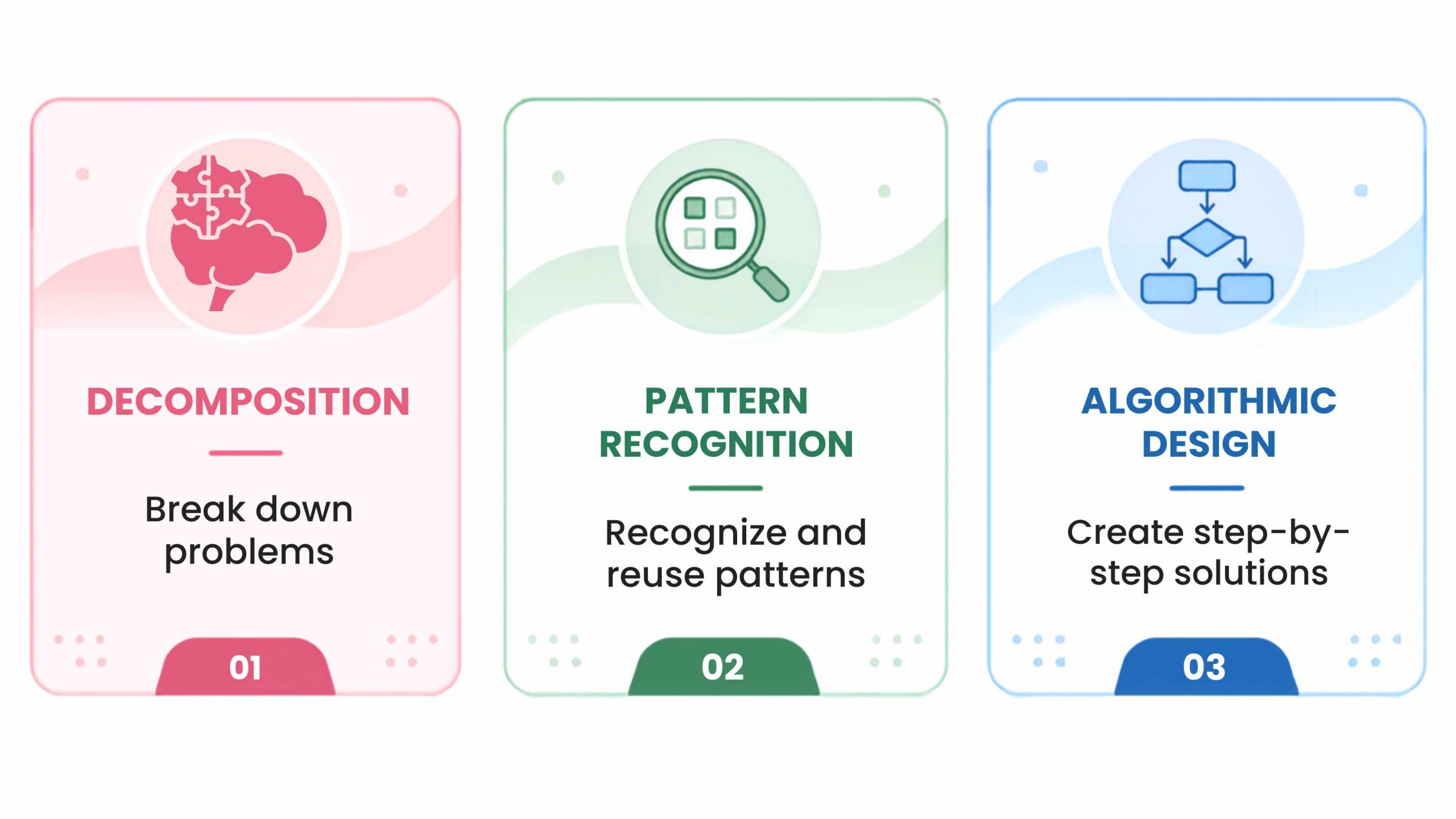
These skills aren’t tied to any single programming language, and they don’t expire when a new AI model launches. Code is simply the clearest, most hands-on way to actually practice them.
Should Schools Teach Coding When AI Can Write Code? The Vibe-Coding Risk
The Risk of Illusionary Competence
AI has made it remarkably easy for a student to feel like a master programmer. A single prompt can produce a working app, website, or game in seconds and that instant success can look identical to real mastery. It isn’t. A 2025 study by Apple’s machine learning team, “The Illusion of Thinking,” tested leading AI models on classic logic puzzles like the Tower of Hanoi, as reported by educators at Computing at School, and found that model accuracy collapsed to zero once problems crossed a certain complexity threshold. Students face the same illusion in reverse: they can ship something that runs, right up until it breaks and then discover they have no idea how to fix it, because they never built the underlying mental model in the first place.
Security, Efficiency, and Bias
The stakes go beyond a broken homework assignment. Recent research covered by InfoWorld found that novice engineers who leaned on AI to learn a new coding library scored 17% lower on retention quizzes than peers who worked manually. It is the sharpest skill loss showing up in debugging, the exact ability needed to catch a security flaw. An inefficient loop, or a biased assumption baked into AI generated code. Without that underlying knowledge, students can’t audit what they’re shipping. They can only trust it, a dangerous habit to build in a generation that will spend entire careers working alongside AI -generated systems they didn’t personally write.
The Human Architecture Edge
This is precisely why the future tech market is shifting its premium toward system architects, not text -prompters. Any student can learn to phrase a request to an AI model. Far fewer will be able to look at the output and know whether it’s actually sound structurally and logically. That’s the skill schools should be protecting and building, because it’s the one skill AI cannot currently replicate on its own. A student who understands system design, not just prompt phrasing, is the student who will still have leverage in a workplace where AI writes the first draft of nearly everything. Coding education, if done right, isn’t training the last generation of programmers, it’s training the first generation of architects who know how to direct AI rather than be replaced by it.
Benefits of Coding Education for Students
Thinking of coding as just a career track is misguided; rather it is a foundational literacy. The Raspberry Pi Foundation’s 2025 position paper lays out a strong evidence-based case for why coding education matters far beyond producing future software engineers.
It Builds Real Problem-Solving Ability
Learning to code is fundamentally about reading, testing, debugging, and rewriting the process of breaking a large problem into small, solvable steps. This is the core of computational thinking, and it is not limited to programming but transfers directly into math, science, and everyday decision-making.
It’s a Cross-Domain Skill, Not Just a Tech-Sector One
Coding is no longer confined to software careers. From healthcare to agriculture, the ability to combine programming with domain expertise is increasingly in demand. The benefits of coding education for students show up regardless of what field they eventually choose, it’s becoming as fundamental as writing or basic statistics.
It Gives Students Agency, Not Just Skills
Understanding how code works means students aren’t passive consumers of technology, they understand the systems shaping their daily lives. Students who learn to code today are more likely to be creators of tomorrow’s digital tools, not just users of them.
The 2026 Action Plan, How to Evolve the K-12 Curriculum
None of these calls for rejecting AI in the classroom, it calls for redesigning how coding is taught around it. Here’s a practical, three-step workflow principals can bring directly to their next department meeting, without needing a full curriculum overhaul to get started.
● Step 1:
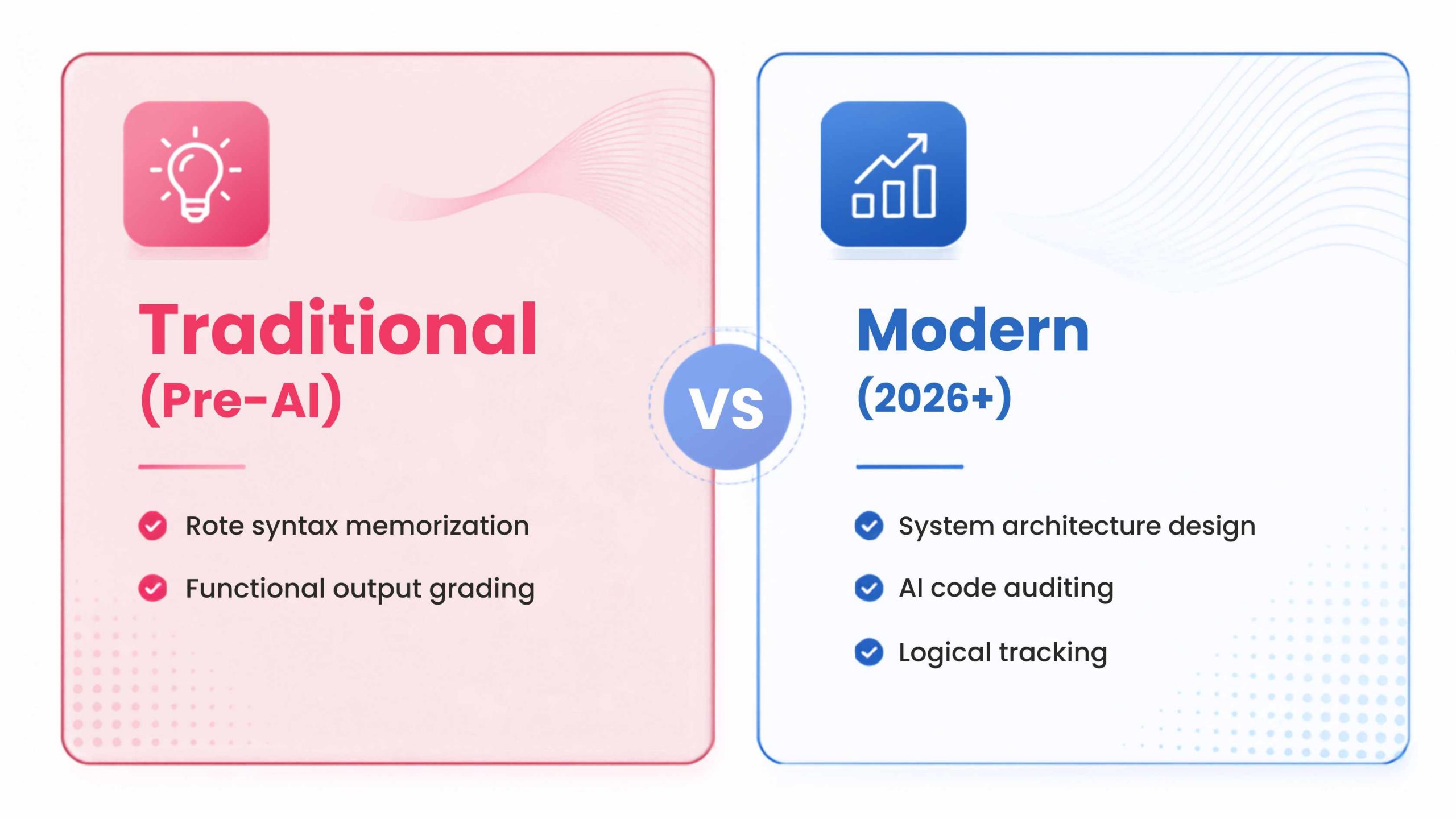
Shift grading rubrics away from functional output and toward logical code auditing. Instead of grading whether a program runs, grade whether a student can explain why it runs, identify what would break it, and describe how they’d fix it. This single change means a working program isn’t enough anymore. Students also have to explain why it works, not just that it does.
● Step 2:
Integrate AI tools explicitly into the lab environment, instructing students to act as code reviewers rather than simple typists. Give students AI-generated code with a deliberate bug, security flaw, or inefficiency built in, and ask them to find it. This turns AI from a shortcut into a teaching aid, and mirrors exactly the kind of work students will be doing in most technical careers within the next decade.
● Step 3:
Focus on early physical computing or logic-block systems tools like Scratch, or simple Python flowcharts before introducing free-form text prompts. Younger students especially benefit from seeing logic made visible and tactile before they’re handed a blank prompt box. Students who build a solid mental model of how logic flows through a system are far better equipped to evaluate AI output later, rather than treating it as an unquestionable black box from day one.
Pitfalls School Leaders Must Avoid
The most common mistake school leaders make in this transition is reaching for a blanket ban. It’s an understandable instinct that banning AI tools feels like the fastest way to protect academic integrity. In practice, it rarely works. Research from Policy Analysis for California Education has tracked exactly this pattern: early district-wide ChatGPT bans in cities like Los Angeles and New York largely failed to slow adoption, since students can access AI tools from any personal device outside school walls regardless of what’s blocked on campus Wi-Fi. What bans do accomplish is pushing AI use underground, away from teacher visibility, and widening the gap between students with tech-savvy support at home and those without. A ban doesn’t stop AI use, it just stops the school from being able to guide it.
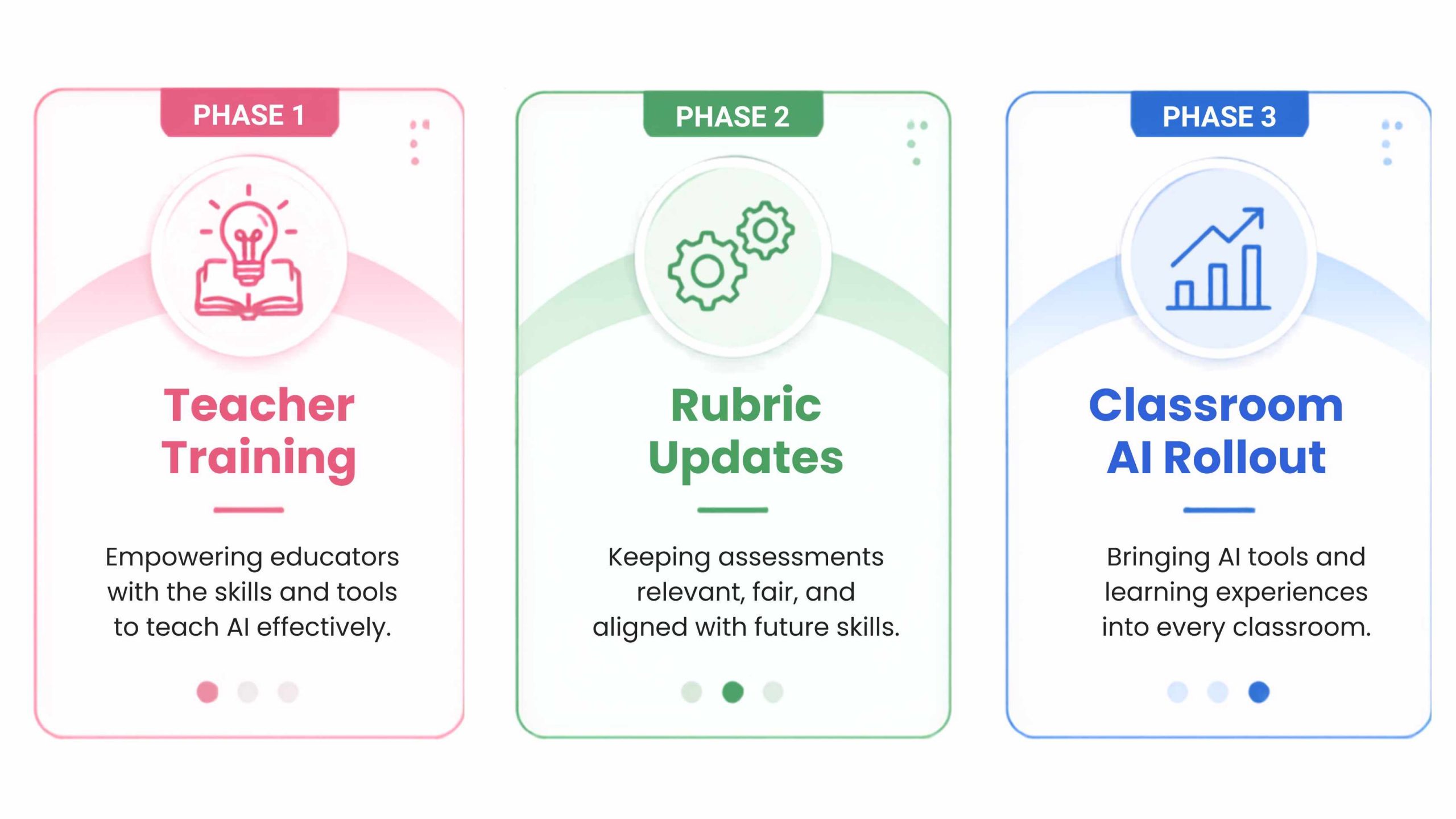
The second common mistake is updating the curriculum before training the people delivering it. A new set of grading rubrics or classroom activities is only as good as the teacher’s confidence in running them. Asking a computer science teacher to suddenly incorporate AI code-review exercises, without first giving them time to practice identifying AI-generated bugs themselves, sets the entire initiative up to stall in its first semester. Professional development needs to come first, not as an afterthought squeezed in after rollout. Budget planning should treat teacher training as a line item with the same priority as any new software license or lab hardware purchase because a curriculum shift without teacher buy-in rarely survives contact with a real classroom.
Conclusion
Five years from now, today’s students will walk into workplaces where AI has already written the first draft of almost everything, the code, the report, the plan. The real test won’t be whether they can produce something. It’ll be whether they can look at what AI handed them and know if it’s actually right. A student who only memorizes syntax will fall behind the ones who can understand the logic behind them. A student who learned to think in systems, catch what’s broken, and question a confident-sounding wrong answer, the core of computational thinking, will be the one people actually listen to.
That’s not a five-year-away problem. It starts with what gets taught in school, and how it gets graded.
Frequently Asked Questions (FAQ)
- Does coding still matter when students can use AI tools like ChatGPT and Copilot?
Answer. Yes, AI can generate code but can’t guarantee it’s correct without someone who understands the reasoning behind it. Codevidhya’s curriculum builds exactly that reasoning, so students learn to evaluate AI instead of just trusting it.
- What are the benefits of teaching coding in schools beyond software development?
Answer. Coding is a way to teach students essential problem-solving skills, not just a way to develop software. It equips them with coding acumen that isn’t limited to computer science, but extends into their day-to-day life.
- How can schools integrate AI into coding education without replacing learning?
Answer. AI can support how students learn to code, not replace the learning itself. It’s useful for correcting mistakes, explaining technical terms in simpler language, or acting as a dialogue partner to dig deeper into a topic.
- What skills should students develop to succeed in an AI-powered future?
Answer. Students heading into an AI-powered future need to be strong problem-solvers first, along with computational thinking, adaptability, and basic AI literacy so they know how to work with these tools thoughtfully.
- What coding curriculum should schools teach in the age of AI?
Answer. Schools should focus on computational thinking, like breaking problems down and building logic, rather than any one language. At Codevidhya, this is the exact approach we bring into partner schools’ classrooms.