


This guide breaks down what the mandate requires by grade level, how prepared most schools currently are, and the practical steps principals can take now to get their teachers ready for 2026-27 rollout
Table of Contents
Is Your School Ready for the AI Curriculum Mandate?
Checking Your School’s Actual Readiness
Most schools are probably not ready yet. That is normal at this stage, and it is not something to panic about. curriculum. The rollout of the NEP (National Education Policy) vision, which is being implemented on the ground through the CBSE, has been staged in phases rather than dropped on schools overnight. CBSE already runs a 15-hour AI readiness module in over 18,000 schools for Classes 6 to 8. Many schools already have a starting point, even if they have not called it AI curriculum integration.
What is changing now is scale. AI education is moving from an elective skill subject to a core part of how Classes 3 to 8 are taught. The curriculum is being developed with IIT Madras and aligned to the National Curriculum Framework for School Education 2023. UNESCO’s report on AI and education stresses that a rights-based approach matters here. Poorly implemented AI education can widen the same access gaps it is meant to close. Nearly a third of the world still lacks reliable internet access, and that gap usually falls hardest on rural schools and under-resourced communities.
A useful readiness check is simple, how many teachers have actually used an AI tool in a lesson, not just discussed one? Most schools score low here right now and that’s normal, not a red flag. This is exactly the stage ED tech channels like Codevidhya, UpGrad and LEAD School works with, helping schools train their teachers through structured, hands-on training programs.
Why Teacher Readiness Matters More Than Devices
Teacher readiness is the real test here, not device counts. One recent study found just over half of teachers, 53.2%, reported using AI tools in their work, though basic school teachers used them more than upper secondary teachers did. The mandate does not expect technical expertise from teachers. It needs a real shift in how lessons get planned and taught.
A good starting point is identifying teachers who are already curious about technology. Usually this is about 10 to 15 percent of staff. Training them early lets them support the rest of the school once the full rollout begins. UNESCO’s guide on integrating AI in vocational institutions makes a similar point. Institutions should build staff capacity before scaling technology. Rolling out tools before teachers are ready usually leads to shallow implementation, not real classroom change. This is where Codevidhya’s teacher training comes in, helping staff build real comfort with AI tools before a school rolls out the curriculum, not after.
Budget and Timeline Planning
Budget planning should reflect this too. Teacher training deserves more priority than new software licenses. Workshops, practice time, and mentorship from schools that have already gone through this shift matter more than an extra set of devices. Connectivity is worth checking honestly as well, since a curriculum built around AI tools assumes a level of internet access that not every campus, or every student’s home, currently has.
It also helps to set realistic internal timelines rather than treating the 2026-27 start date as a single fixed deadline. A school that starts with an honest audit of teacher comfort levels this term has time to run a small pilot in a classroom or two before deciding what a full rollout should look like. Schools that wait until the final term before the mandate begins tend to compress all of that preparation into a rushed few weeks, which is exactly the scenario principals should be trying to avoid.
How NEP 2020 Is Integrating AI in Schools
The Government’s Layered Rollout
NEP 2020 AI as a skill built into everyday learning treats, not a separate technical subject.It falls under digital literacy goals, not a specialized track for future engineers.
The government’s approach is layered. Curriculum development is led by subject experts. Teacher training runs through the NISHTHA program, aiming to reach over one crore teachers with grade-specific modules.
State-Level Examples Worth Knowing
Several states are already testing their own versions. Punjab has proposed a rollout spanning Classes 1 to 12. Madhya Pradesh has combined AI into curriculum reform, teacher training, and school governance at the same time. Northeast India shows a smaller-scale example worth knowing. NagaEd launched an AI-powered teacher accessible through WhatsApp, aligned with NCERT and local curricula. It reaches students in both urban and remote areas without needing expensive lab equipment.
Support Structures Already in Place
The National Curriculum Framework for School Education 2023 already laid some of this groundwork, treating computational thinking as something that should show up across subjects rather than living only in a computer lab period. This is one reason the mandate feels less like a sudden shift and more like the next step in something already underway. Schools that engaged seriously with NCF-SE 2023 are likely to find this transition smoother than schools encountering computational thinking for the first time.
The Ministry of Education has also set up Centres of Excellence in AI for Education, working with state governments to test curriculum models before they scale nationally. This mirrors how the PARAKH Rashtriya Sarvekshan 2024 survey was used to track outcomes under NIPUN Bharat before wider rollout, so there is precedent for testing an approach at scale before every school is expected to adopt it identically.
For principals, this matters because schools are not expected to build a curriculum from scratch. The framework and training material are being built centrally. The real job for schools is preparing staff and students to use what is coming, not inventing a parallel curriculum. Codevidhya fits into exactly that part of the job, helping schools prepare for what’s already being built, rather than building something separate.
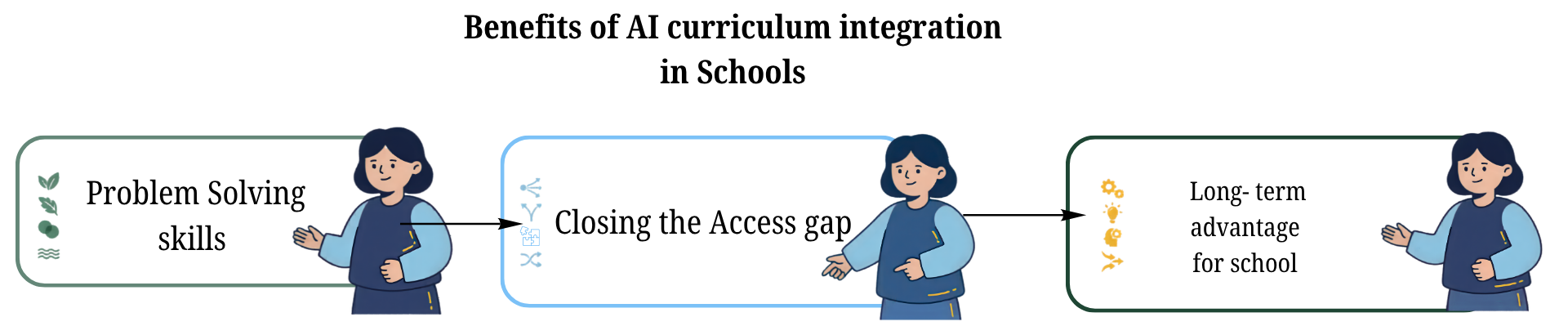
Benefits of AI Curriculum Integration in Schools
Problem-Solving Skills Beyond the Classroom
There is a real case for this shift beyond meeting a deadline. Early exposure to computational thinking helps students build structured problem-solving skills. This carries into math, science, and everyday decisions, long after they forget the specific tools used to learn it.
There is also a workforce angle parents raise often. Healthcare, finance, and most other industries are already shaped by AI. Students who enter the job market with no exposure to how these systems work start at a disadvantage. China and the United States have already built AI into teacher training and classroom instruction at scale. India’s policy is framed as keeping pace with that shift.
Closing the Access Gap
There is an equity dimension worth naming directly. When AI literacy becomes part of the mandatory curriculum rather than an optional add-on, it stops being a benefit only available to schools that could already afford extra classes or private coding programs. A government-mandated, centrally supported rollout is one of the few realistic ways to close that gap at national scale, rather than leaving it to individual schools or families to bridge on their own.
Policy on paper and policy in a classroom are two different things, though. A circular can mandate a curriculum, but it can’t train every teacher or set up every classroom on its own. That’s usually where private-sector partners come in, delivering the actual training, materials, and support that turn a government mandate into something a school can realistically run. Codevidhya operates in exactly that gap, working alongside schools to make the policy usable in practice, not just compliant on paper. Schools that move early also gain a practical advantage. Parents are starting to ask about AI readiness the way they once asked about computer labs. A school that can speak confidently about its approach, with trained teachers and real classroom examples, stands out from one that rushes it at the last minute.
Long-Term Advantages for Schools
Schools that build genuine AI fluency now are also better positioned for future policy shifts. NEP 2020 has already shown, through NIPUN Bharat’s literacy gains, that centrally driven programs can produce measurable results when schools engage with them seriously rather than treating them as paperwork. The same pattern is likely to hold here. Schools that treat this as real curriculum change, not compliance, will see it show up in how confidently their students handle unfamiliar problems later on.
There is a smaller benefit too. Teachers who go through real AI training tend to get more confident with technology in general. That comfort with testing new tools and adapting lesson plans carries into their whole classroom, and that confidence is often where real classroom innovation starts.
None of these benefits require a school to get everything right immediately. A school that starts with one trained cohort of teachers and one grade level, and expands from there based on what actually works in its own classrooms, ends up with a stronger program than one that tries to launch fully formed across every grade at once. The mandate sets the deadline, but how a school gets there is still very much up to the people running it.
Conclusion
AI curriculum integration in schools is not something principals can put off. It comes with a fixed timeline, and schools that prepare now will be better positioned than those that wait. Much of the curriculum and training is being built centrally, so schools do not need to build extensive capacity in-house. They can instead look to private-sector players, Codevidhya among them, to help deliver what the policy already requires.What principals control is how early their staff gets comfortable with it, and how honestly they assess where their school actually stands today. That head start, backed by a policy that already has real results behind it through programs like NIPUN Bharat, is what separates a smooth rollout from a rushed one.
Frequently Asked Questions
- Is AI curriculum integration mandatory for all schools in India?
Answer. Yes. AI and computational thinking become mandatory from Class 3 onward starting the 2026-27 academic year, under CBSE and NCERT guidance aligned with NEP 2020.
- Do teachers need to be AI experts to teach this curriculum?
Answer. No. Teachers need working familiarity with AI and computational thinking, not deep technical expertise.
- At what grade level does this policy introduce AI concepts to students?
Answer. From Class 3, with depth increasing gradually through middle and secondary school.
- How should schools prepare before the official training rollout arrives?
Answer. Start by training a small group of tech-curious teachers early, so they can support the rest of staff once the full rollout begins instead of everyone starting at zero. Codevidhya runs this kind of early-readiness training for schools that want a head start before the mandate hits.
- What is the fastest way for a school to get AI curriculum-ready?
Answer. Partnering with a provider that already has NEP-aligned material and trained facilitators is faster than building a curriculum in-house from scratch. Codevidhya offers exactly this kind of ready-made support for schools preparing for the rollout.